Boss Bar
Shows a large, Dark Souls-style health bar for your boss at the top of everyone's screen, so the whole table can watch it go down. You can show several bosses at once, and choose a different look for each of them.
Getting Started
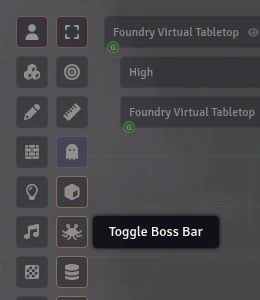
- On the scene, select the boss token (or several tokens).
- In the
Token Controlson the left, clickToggle Boss Bar. The Boss Bar Configuration window opens. - Next to the boss, pick a style and click
Add. - Click
Save.
The boss bar appears at the top of the screen for everyone viewing the scene. When the boss takes damage or is healed, the bar updates on its own.
The boss bar belongs to the scene: it shows up whenever players view that scene, and disappears when they move to another one. Only the GM can set it up.
Boss Bar Configuration
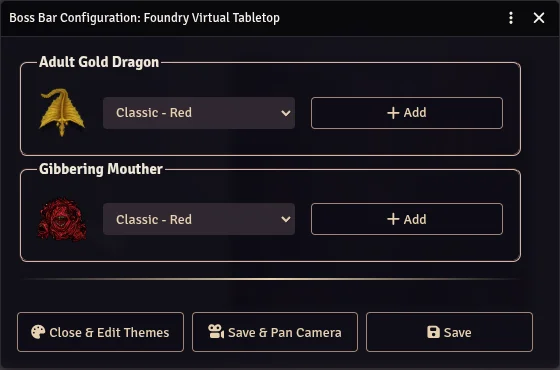
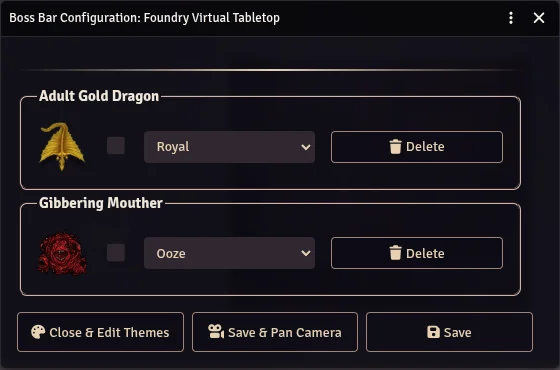
Open it with the Toggle Boss Bar button, or by right-clicking the boss bar.
The window lists the creatures you can add: the selected tokens, or every token on the scene if none is selected.
Each one has a style dropdown and an Add button. When only one token is selected and the scene has no boss bar yet,
it is added straight away.
The creatures already on the boss bar appear at the top, each with:
- Checkbox: hide the creature's name on the bar, for a boss the players should not know yet.
- Style: how its bar looks (see Styles).
- Delete: remove it from the boss bar.
At the bottom:
- Close & Edit Themes: close this window (without saving) and open the Boss Bar Styles window.
- Save & Pan Camera: save, then zoom every player's view onto the boss for a dramatic entrance.
- Save: save the changes.
To remove the boss bar, delete all the creatures and click Save.
The Boss Bar
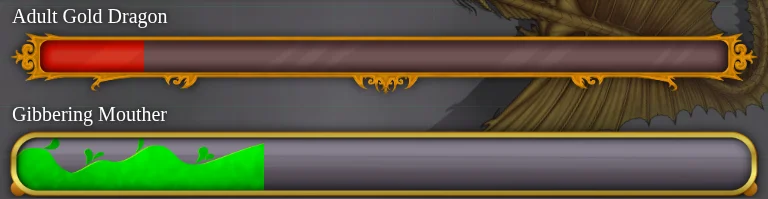
Each boss has its name and a bar showing its current hit points. With the Classic styles, damage leaves a grey
section showing the hit points just lost, which shrinks away after a few seconds.
Every user can place the bar where they like on their own screen: drag it to move it, and drag its bottom-right corner
to resize it. To put it back in the middle at the top, turn on Reset Position in the module settings.
Styles
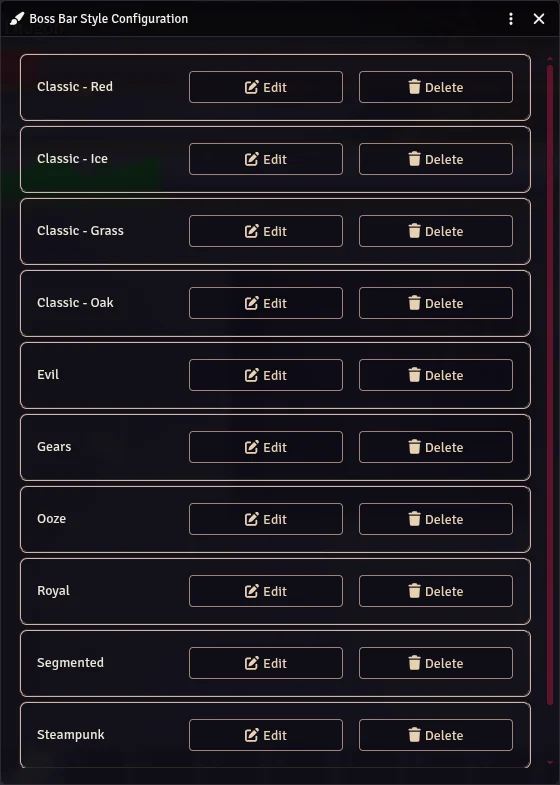
The module comes with ten styles: four Classic bars (Red, Ice, Grass and Oak) and six decorated ones (Evil,
Gears, Ooze, Royal, Segmented and Steampunk). To manage them, open Game Settings -> Configure Settings ->
Bossbar -> Configure Styles, or click Close & Edit Themes in the Boss Bar Configuration.
- Edit: change a style (see below).
- Delete: remove a style.
- Add Style (at the bottom of the list): create a new style. Give it a name, then click its
Editbutton to set it up.
Editing a Style
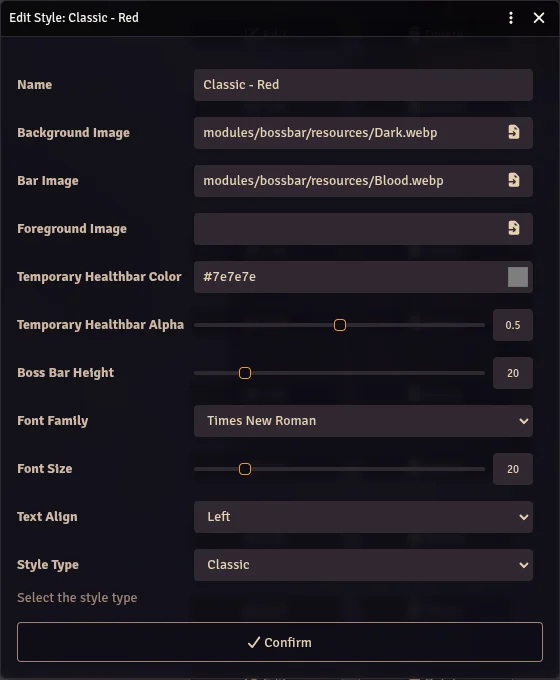
- Name: the name shown in the style dropdown.
- Background Image, Bar Image, Foreground Image: the images the bar is made of, from back to front. The bar image is the part that shrinks as the boss loses hit points; the foreground is an optional frame drawn on top.
- Temporary Healthbar Color and Temporary Healthbar Alpha: the color and opacity of the section showing the
hit points just lost (
Classiconly). - Boss Bar Height: the height of the bar in pixels (
Classiconly). - Font Family, Font Size, Text Align: how the boss name is written.
- Style Type:
Classic: the images are stretched to fit the bar, so any texture works.Matching Images: the three images are drawn at their own shape and size, stacked on each other. Use it for decorated bars: draw the background, bar and frame as three images of exactly the same size.
Settings
- Reset Position: put your boss bar back in its default place (each user sets it for themselves).
- Current HP Path, Max HP Path, Wounds System: where the bar reads the hit points; see Other Game Systems. The defaults work for D&D 5e.
Advanced
Other Game Systems
The bar reads the creature's hit points from two data paths inside the actor's system data: Current HP Path
(default attributes.hp.value) and Max HP Path (default attributes.hp.max). Many systems use the same paths.
If yours doesn't, find where it stores hit points: select a token and type _token.actor.system in the browser
console (F12), then follow the object down to the current and maximum values and write their paths, dot-separated.
If your system counts wounds (damage taken, going up) instead of hit points (going down), turn on Wounds System:
the bar is then full at 0 wounds and empty at the maximum.
Macros
Put the selected tokens on the boss bar, replacing any bosses already there. style is a style id (see below).
canvas.scene.setFlag("bossbar", "actors", canvas.tokens.controlled.map(t => ({ uuid: t.actor.uuid, style: "default", hideName: false })));Remove the boss bar from the current scene:
canvas.scene.unsetFlag("bossbar", "actors");List the style names and ids:
console.table(game.settings.get("bossbar", "barStyles").map(s => ({ name: s.name, id: s.id })));The built-in ids are default (Classic - Red), default-ice, default-grass, default-oak, evil, gears,
ooze, royal, segmented and steampunk.