Argon Combat HUD
A large, video-game-style action bar at the bottom of the screen, inspired by Solasta. It shows the selected character's portrait, hit points and movement, and groups everything it can do by action type, so players (and new players especially) find their attacks, spells and abilities without opening the character sheet.
Argon is made of two parts: this core module, and a module for your game system that fills the HUD. This page describes the core features and the D&D 5e module, which is made by the author; the other systems are maintained by their communities and may work differently.
Getting Started
Install the module for your system too (for D&D 5e, Argon - Combat HUD (DND5E) (opens in a new tab)), or the HUD will have nothing to show.
- Select your token.
- Click
Toggle Argon Combat HUD(the crossed swords) in theToken Controlson the left, or pressShift + A.
The HUD opens at the bottom of the screen. Click the button again, or press Shift + A, to close it.
To have it open by itself, turn on Always On (it opens whenever you select a token) or Open on Combat Start.
Supported Systems
- Dungeons & Dragons 5e (opens in a new tab)
- Coriolis (opens in a new tab)
- Dragonbane (opens in a new tab)
- Mutant Year Zero (opens in a new tab)
- Pathfinder 2nd Edition (opens in a new tab)
- Vaesen (opens in a new tab)
- Starfinder (opens in a new tab)
- Star Wars 5e (opens in a new tab)
- Twilight: 2000 (opens in a new tab)
Your system isn't listed? Ask in your system's Discord channel whether someone is working on it. Developers can use any existing system module as a template (see Making a System Module).
The HUD
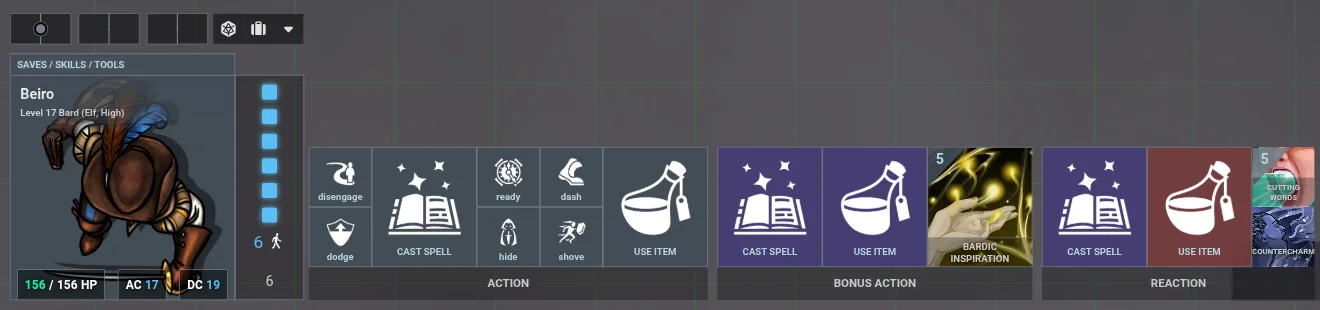
From left to right:
- Portrait: the character's name, level and class, hit points, armor class and spell save DC. Hover over its
top-right corner for more buttons:
- Roll Initiative (the d20).
- Open Character Sheet (the suitcase).
- Minimize: shrink the HUD down to the portrait.
- Configure (the gear): settings for this actor.
- Movement: one box for each square the token can move this turn (see Movement).
- Action panels: the character's options sorted into
Action,Bonus ActionandReaction(and, for monsters that have them, legendary, lair and mythic actions). - End Turn: on the character's turn, a button to pass the turn to the next combatant.
Out of combat, Long Rest and Short Rest buttons are shown too.
Using an Action
- Left-click a button to use it, exactly as from the character sheet.
- Right-click it to open the item's sheet.
- Hover over it to see a tooltip with its range, to-hit, damage and description.
Big buttons like Cast Spell and Use Item open a panel with the matching spells or items. A number on a button
shows how many uses or charges are left.
The basic actions everyone has (dodge, disengage, dash, hide, ready, shove) have small buttons of their
own.
Spells
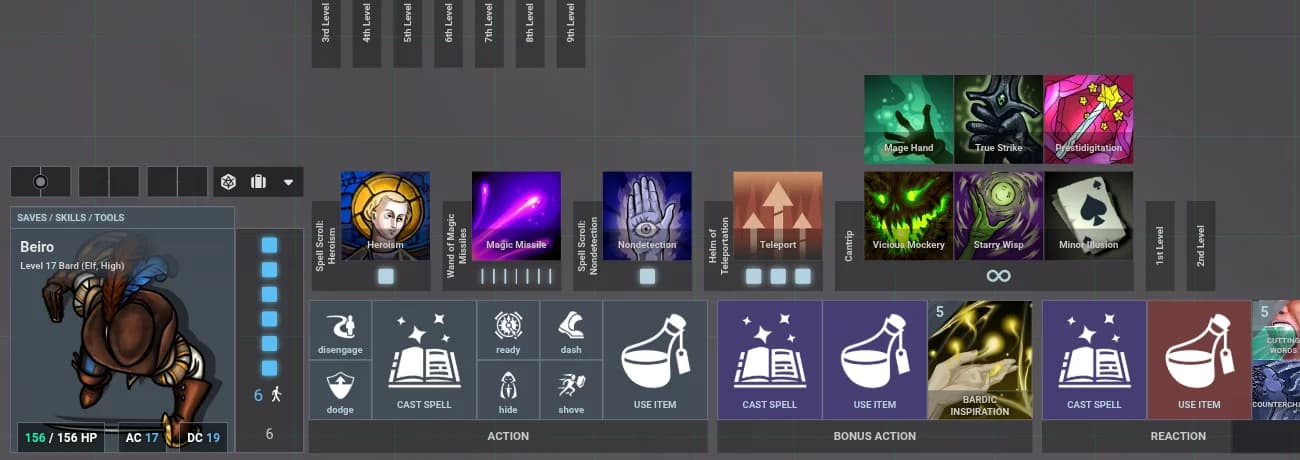
Cast Spell opens the spells, grouped by level. Click a level to expand or collapse it. Under each group, the pips
show the spell slots left (an infinity sign for cantrips). Items that cast spells, like scrolls and wands, are listed
too, with their charges.
Action Tracking
When a character uses an action, bonus action or reaction during its turn, that panel is darkened as used. This is only a reminder: it never stops anyone from acting, and there is no undo. Closing and reopening the HUD resets it.
Saves, Skills and Tools
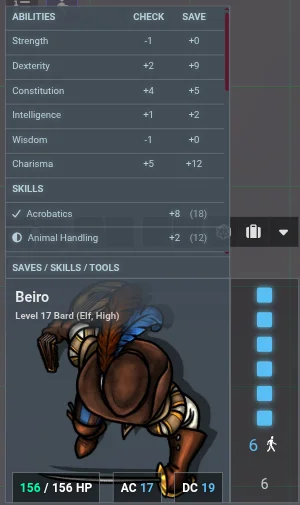
Click Saves / Skills / Tools above the portrait to open a list of ability checks, saving throws, skills and tools,
with their bonuses. Click any of them to roll it. Click the title again to close it.
Weapon Sets
Above the portrait are three weapon sets, each with two slots: the left slot is used with an action, the right one with a bonus action. Click a set to switch to it: its items appear first in the action panels.
- To put an item in a slot, drag it from the character sheet onto the slot.
- To empty a slot, drag the item out of it, or right-click it.
Monsters get their sets filled automatically from their weapons. Sets are not only for weapons: a caster can keep favorite cantrips there.
With Auto Equip on, switching sets also equips the items of the new set and unequips the others.
Movement
The movement bar counts how many squares the token has moved this round: it turns yellow when the character would need to Dash, and red when it has moved too far.
Target Picker
The target picker only helps you pick targets: it doesn't add any automation. It reads how many targets an item needs from the item itself.
With Target Picker on, clicking an action that needs targets lets you pick them on the scene first:
- A counter next to the cursor shows the targets picked and needed.
- Left-click a token (or press
Twhile hovering it) to target it. - Press
+or-to change how many targets are needed. - Right-click to cancel.
Themes
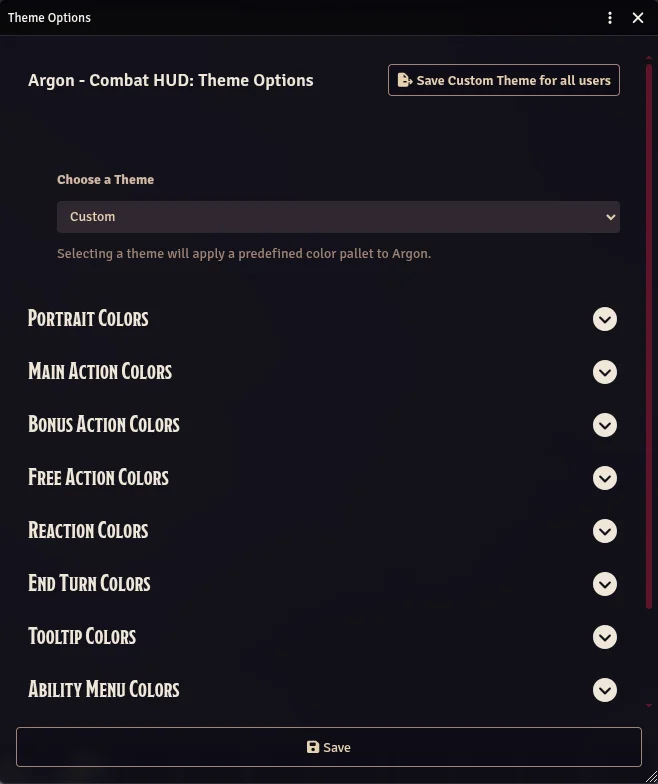
Open Game Settings -> Configure Settings -> Argon - Combat HUD (CORE) -> Configure Themes.
- Choose a Theme: pick one of the ready-made color schemes (
Argon,Cobalt,Foundry Dark,Helium,Krypton,Neon,Tin,Xenon...). - Expand a section (
Portrait Colors,Main Action Colors,Tooltip Colors...) to change single colors. The theme becomesCustom. - Click
Save.
By default each user picks their own theme. To use the same theme for everyone, the GM sets Theme Mode to World
and makes the theme; the GM can also share a custom theme with Save Custom Theme for all users.
Settings
Open them from Game Settings -> Configure Settings -> Argon - Combat HUD (CORE). The settings marked
(per user) are chosen by each user for themselves.
For the whole table (GM):
- Theme Mode:
Clientlets every user choose their theme,Worlduses the GM's theme for everyone. - 3D Canvas - Range Finder: with 3D Canvas, hovering an action shows the distance to the target, in red when it's out of range.
- Target Picker: see Target Picker.
- Target Picker - Clear Targets: clear the current targets before picking new ones.
- Open on Combat Start: open the HUD when a combat starts.
- Dialog Theme: give the dialogs opened from the HUD (like the spell slot dialog) the HUD's colors.
- Suppress Warnings: don't show a warning when something goes wrong.
Per user:
- Auto Scale: size the HUD to fit the screen.
- Scale: the size of the HUD when
Auto Scaleis off. - Always On: open the HUD whenever you select a token.
- Left Position, Bottom Position: the distance in pixels from the left and bottom edges of the screen.
- Hide Macro Bar and Player list: hide them while the HUD is open, to make room.
- Player Details on Bottom: show the name and class at the bottom of the portrait instead of the top.
- Show Tooltips and Tooltip Scale: show tooltips on hover, and their size.
- Fade Out, Fadeout Delay, Fadeout Opacity: fade the HUD out when the mouse leaves it, after the delay in seconds, down to the opacity chosen.
- Disable Blur Effects: turn off the blurred backgrounds. Only use it if the HUD makes Foundry slow.
D&D 5e Settings
In Configure Settings -> Argon - Combat HUD (DND5E):
- Show Weapons in 'Use Item' Section: also list weapons under
Use Item, for characters with more weapons than weapon set slots. - Show Class Actions: show class features (like
Bardic Inspiration) directly in the action panels. - Condense Class Actions: show class actions as small buttons, two per column, to save space.
- Expand Items into Activities: when an item can be used in several ways (its activities, like a weapon's attack
and its throw), show one button for each:
Only expand weapons,Always expandorNever expand. - Macro Panel: add a panel with the character's hotbar macros.
- Auto Equip: equip and unequip items when switching weapon sets.
- Show Basic Actions: show the
dodge,dash,disengage,hide,readyandshovebuttons.
Advanced
Troubleshooting (D&D 5e)
An item doesn't show up in the HUD. Argon only shows items that have an activity, and the item's first activity
must take an Action, Bonus Action, Reaction or Special activation.
How do I show an item directly in the action bar? Class features are shown directly (with Show Class Actions
on). Set the item's type to a class feature to show it there.
The HUD looks wrong. Argon is made for Chrome-based browsers. If parts of it look broken, try another browser.
Macro
Open or close the HUD for the selected token:
ui.ARGON.toggle();Making a System Module
System modules should follow this naming scheme, so users can find them:
- Module
id:enhancedcombathud-<systemid>, in lowercase. - Module
title:Argon - Combat HUD (<SYSTEMID>), in uppercase.
For example, the D&D 5e module is id: enhancedcombathud-dnd5e, title: Argon - Combat HUD (DND5E). The
D&D 5e module's source (opens in a new tab) is a good starting point.
Credits
- UI/UX design by mouse0270 (opens in a new tab).
- Icons from game-icons.net (opens in a new tab).