Gatherer
Let your players gather, fish, mine, hunt and scavenge. Each gathering spot is a journal page linked to a Rollable Table: players draw items from it, with optional skill checks, limited uses that come back over time, and minigames. Place spots on the map so players can gather where they stand, and harvest materials from defeated creatures.
Want to start with some ready-made gathering spots and recipes? Install the D&D 5e Potion Crafting & Gathering (opens in a new tab) module by Action_Jay (opens in a new tab). It uses both Gatherer and Mastercrafted.
Getting Started
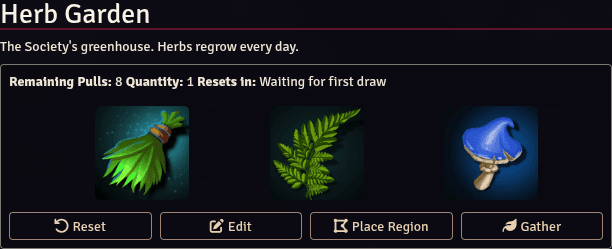
Create your first Gathering Spot
- Create a Rollable Table and drag in the items players can find. Give common items a higher weight.
- Create a journal entry (or open one) and add a page of type
Gatherer. - In the
Sourcetab, drag the table ontoRollable Table. - In the
Limitstab, setPullsto10andRespawn Timeto24: the spot can be gathered 10 times, then refills after a day of in-game time. - Close the page.
You have created your first Gathering Spot! The page shows the items that can be found (hover one to see its chance), the pulls left and when the spot refills.
Gather
- Select a token, or make sure you have an assigned character.
- Open the page and click
Gather.
The character rolls the checks (if any), the table is drawn, the items go to their inventory and a message is posted in
the chat. The GM can click Reset to refill the spot at any time, Edit to change it and Place Region to put it on
the map (see Gatherer Nodes).
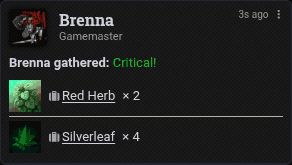
A GM must be connected for players to gather. Only items in the table are added to the inventory: other results (text, actors, ...) are just posted in the chat.
Gathering Spot Settings
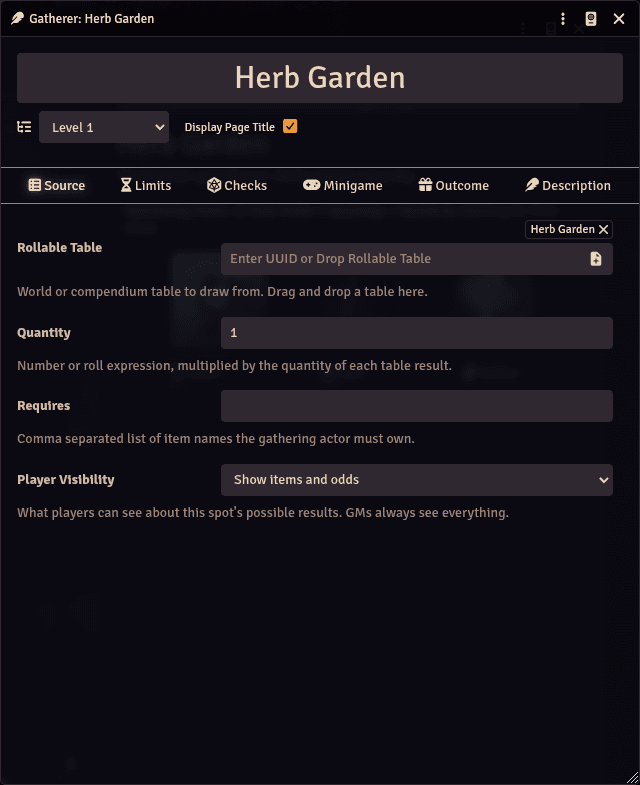
Open the page with Edit to change its settings, split in tabs.
Source
Rollable Table: the world or compendium table to draw from.Quantity: how many of the drawn item are gathered, as a number or a roll like1d4+1.Requires: item names the character must own to gather here, separated by commas, for exampleFishing Rod, Bait. They are not used up.Player Visibility: what players see on the page:Show items and odds,Show items, hide odds, orHide items until gathered(items show as unknown until someone finds them). The GM always sees everything.
To give one item its own quantity, open the table, switch it to edit mode and fill the Quantity column of that
result (a number or a roll). It is multiplied by the page's Quantity.
Limits
Pulls: how many times the spot can be gathered before it is exhausted. Leave it blank for unlimited.Pulls per Character: how many times each character can gather until the spot refills.Respawn Time: hours of in-game time before the spot refills. The timer starts with the first pull. Leave it blank to never refill.Respawn Mode:Full reset after the time passes, orRegain one pull each time the time passes.Failed Attempts Use a Pull: when off, only successful attempts use pulls, so characters can try again.
Spots refill as in-game time passes. You need a way to move time forward, like Simple Timekeeping & Calendar (opens in a new tab).
Limits only work on pages in your world. A page opened straight from a compendium can be gathered without any limit or timer: import its journal first.
Checks
Click Add Check, pick an ability, skill or tool check and set the DC. Every check must succeed: if one fails,
nothing is gathered (and the Mishap Table is drawn, see Outcome). Checks work in any game system supported
by TheRipper93's System Abstraction (opens in a new tab). Hold Alt or Ctrl
when clicking Gather to roll with advantage or disadvantage, as with the system's own rolls.
Expression runs a script or macro instead, see Expressions.
Minigame
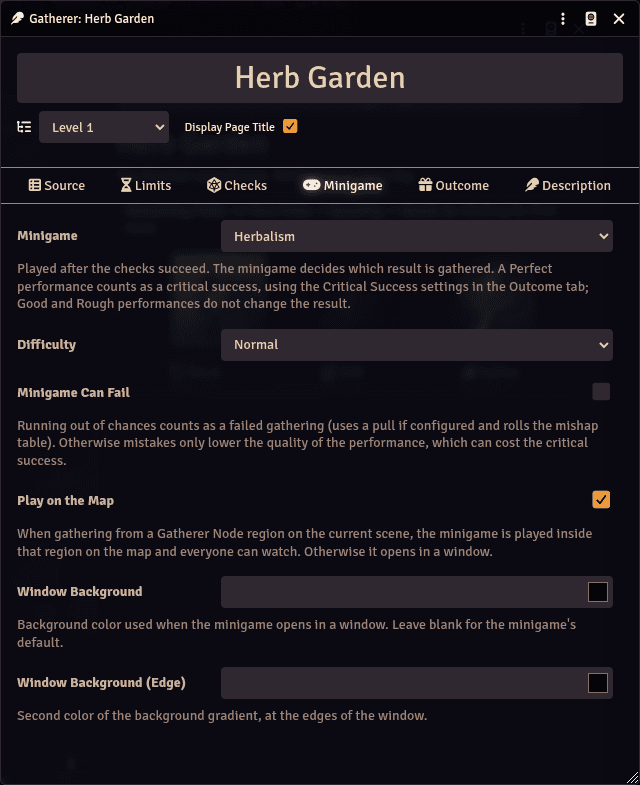
A minigame lets the player pick what they gather by skill instead of luck. It is played after the checks succeed:
- Classic (item roulette): the table's items flash by, the rarer ones for a shorter time, faster and faster. Click
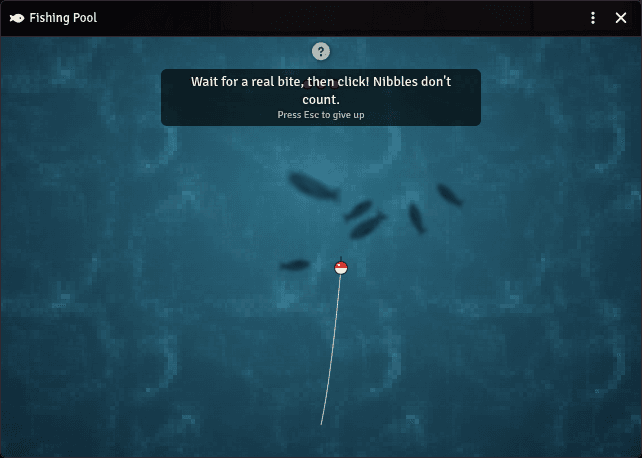
Gatherto take the one on screen. - Fishing: click the water to cast, wait for a real bite (nibbles don't count), then reel in while keeping the marker in the green zone.
- Mining: click each weak point of the rock as its ring closes in.
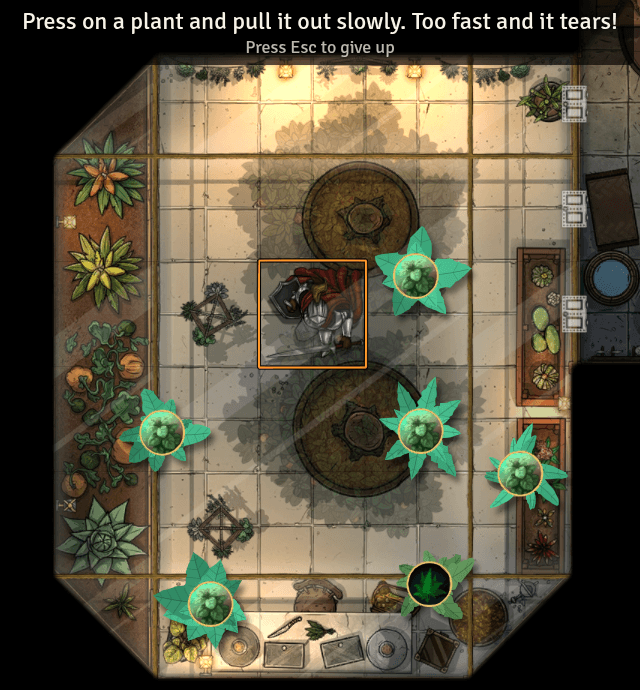
- Herbalism: press on a plant and pull it out slowly, or it tears.
- Hunting: hold to draw the bow, release to shoot, and lead your moving target.
- Harvesting: press a glowing mark and trace the cut line without leaving it.
Options:
Difficulty:Easy,NormalorHard.Minigame Can Fail: running out of chances fails the gathering (it uses a pull if set, and draws the Mishap Table). When off, mistakes only lower the quality.Play on the Map: when gathering from a Gatherer Node, the game is played inside the region on the map, and everyone can watch. Otherwise it opens in a window.Window Background/Window Background (Edge): the colors of the window.
A Perfect performance counts as a critical success. The ? button shows how to play and Esc gives up. The
Disable Minigames setting turns all minigames off for everyone.
Outcome
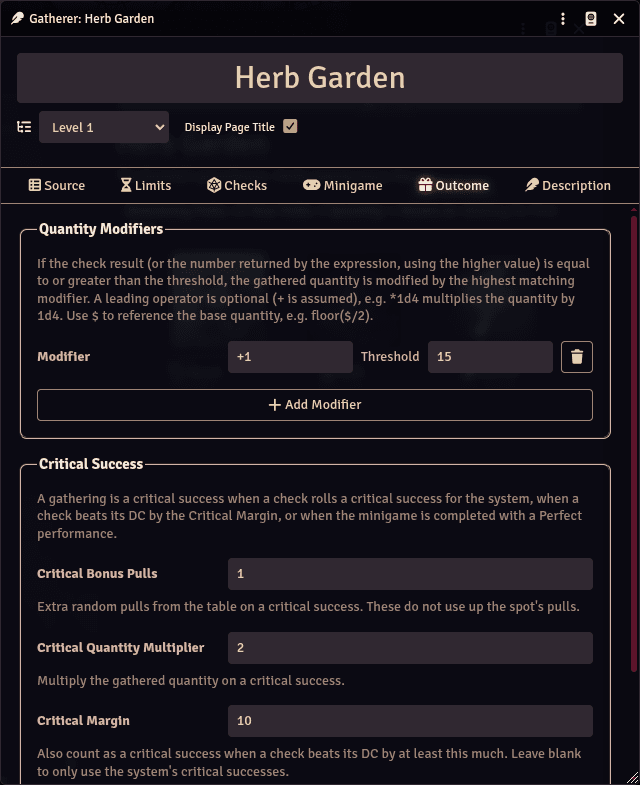
- Quantity Modifiers: gather more on a good roll. Click
Add Modifierand set aModifierand aThreshold: when the best check result reaches the threshold, the quantity changes. Start the modifier with+,-,*or/(+if you write none);$is the base quantity, e.g.floor($/2). When several match, the highest threshold wins. - Critical Success: a check that rolls a critical for the system, a check that beats its DC by the
Critical Margin, or a perfect minigame. It givesCritical Bonus Pulls(extra draws that don't use up the spot) and multiplies the quantity by theCritical Quantity Multiplier. Mishap Table: drawn when the gathering fails. Its items are given to the character and the result is posted in the chat, for example a thorn prick or a stolen bait.
Gatherer Nodes
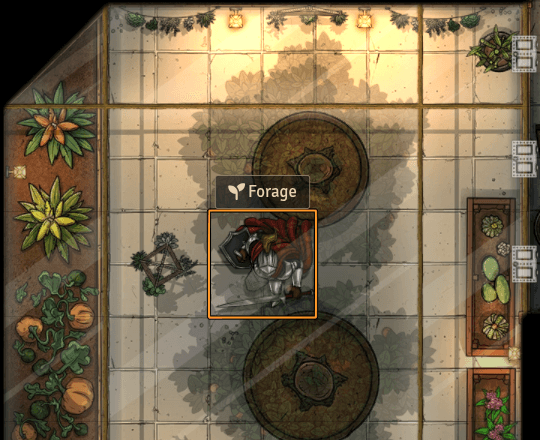
A Gatherer Node puts a gathering spot on the map: players walk their token there and gather with one click.
- Open the Gatherer page and click
Place Region. The page is minimized and the polygon tool of the Regions controls is selected. - Click and drag to draw the first side of the area, click to add each other corner, and double-click to finish. Right-click removes the last corner; switching to other scene controls cancels.
- The region is created with the name of the page and a
Gatherer Nodebehavior already linked to it. The behavior's settings open: change them if you need to, then close the window.
You can also do it by hand: draw any Region, add a Gatherer Node behavior in its Behaviors tab and drag the
Gatherer page onto Gatherer Page.
When a player selects a token inside the region, a button appears above it. Its name follows the minigame (Fish,
Mine, Forage, Hunt, Harvest, or Gather). It disappears while the node is exhausted.
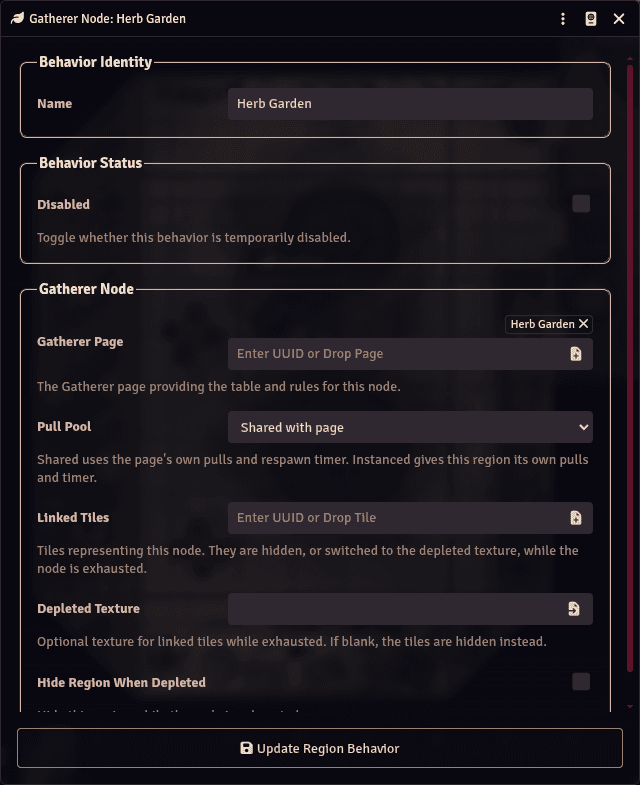
Pull Pool:Shared with pageuses the page's pulls and timer, so every node linked to the page shares them.Instancedgives this region its own pulls and timer: use one page for all the berry bushes of your world, each with its own stock.Linked Tiles: tiles that show the resource, like a tree or an ore vein. While the node is exhausted they are hidden, or show theDepleted Textureif you set one.Hide Region When Depleted: hides the region itself while exhausted.
Harvesting
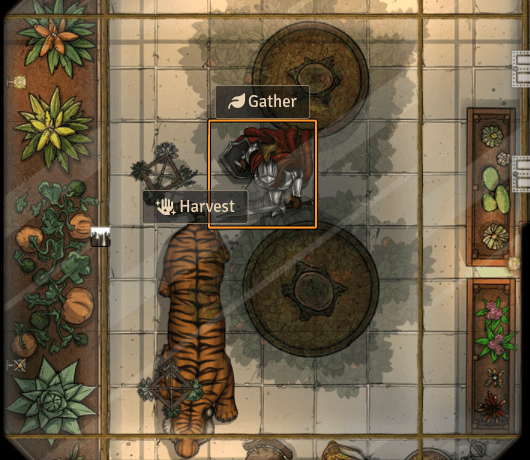
Players can harvest materials from defeated creatures: hides, fangs, scales.
A creature can be harvested when it is at 0 health or has the Defeated status, and is not in a running combat. A
Harvest button appears over it for players whose token is close enough (and for the GM). Players can also target the
creature and press Shift + G.
Harvest by Creature Type
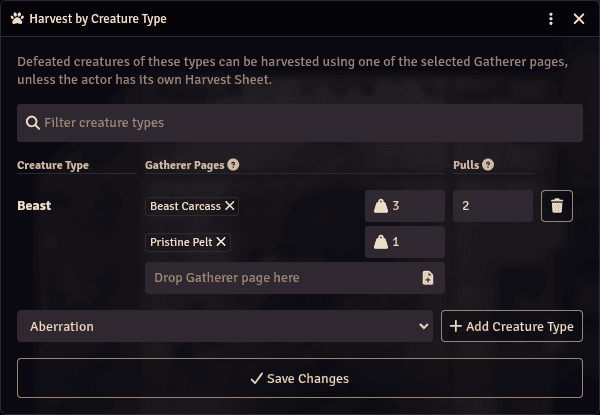
The quickest setup: assign pages to whole creature types.
- Open the module settings and click
Configurenext toHarvest by Creature Type. - Choose a creature type (for example
Beast) and clickAdd Creature Type. - Drop one or more Gatherer pages on it. With several pages, one is picked at random on every harvest: the number next to each page is its weight (3 is three times as likely as 1).
- Optionally set
Pulls: how many times each creature can be harvested. - Click
Save Changes.
Harvest a single creature
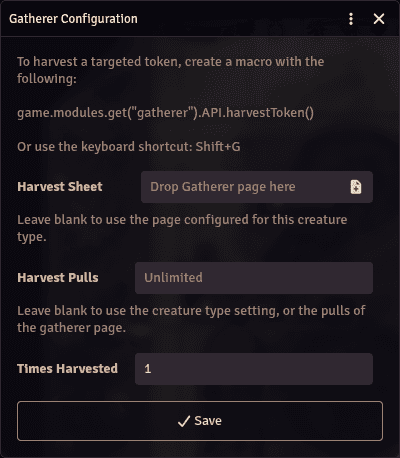
To give one creature its own loot, open its sheet and choose Gatherer in the title bar menu (⋮). This is available
for creatures without a player owner.
Harvest Sheet: drop a Gatherer page here. It replaces the creature type pages.Harvest Pulls: how many times it can be harvested. Blank uses the creature type setting, then the page's pulls.Times Harvested: how many times it was harvested; set it back to0to allow harvesting again.
Settings
Enable Harvesting: turns Harvesting on or off.Harvest Range: how close, in grid spaces, a token must be to see theHarvestbutton.1means adjacent.Disable Minigames: skips every minigame; gathering uses the checks alone.Harvest by Creature Type: see Harvest by Creature Type.Migrate on Startup: converts pages from older versions again the next time the world loads, then turns itself off. See Updating from older versions.Harvest Targeted Token(inConfigure Controls): the harvest key,Shift + Gby default.
Advanced
Updating from older versions
Gatherer needs the TheRipper93's System Abstraction (opens in a new tab)
module. If it is installed but turned off, the GM is asked to turn it on when the world loads: click
Enable and Reload.
The first time a GM opens a world after updating, Gatherer pages made with older versions are converted automatically.
If something needs your attention, a Gatherer - Migration Report window lists it: pages whose table or checks could
not be converted, and locked compendiums that were skipped.
To convert pages you import later, or the ones in a compendium that was locked:
- Unlock the compendium (right-click it ->
Unlock). - Turn on the
Migrate on Startupsetting. - Reload the world.
Expressions
The Expression field in the Checks tab runs a script, or the macro with that name, before gathering. actor is the
gathering character. Return:
falseto fail the gathering,- a number to use as the check result for the Quantity Modifiers.
This Investigation check succeeds on 15 or more and passes its total to the modifiers:
const roll = await actor.rollSkill({ skill: "inv" });
return roll[0].total >= 15 ? roll[0].total : false;
Macros and API
Gather from a page without opening it (the actor is optional: by default the selected token or assigned character):
game.modules.get("gatherer").API.gather("JournalEntry.CFn2RzFEskvetNZy.JournalEntryPage.nFcrnFCbWH8wHDPV", "Actor.OcOyw1pt7EKZ1oMC");Harvest a token (by default your first target):
game.modules.get("gatherer").API.harvestToken(token);Refill a gathering spot (a page, or an Instanced node behavior):
game.modules.get("gatherer").API.reset(fromUuidSync("JournalEntry.CFn2RzFEskvetNZy.JournalEntryPage.nFcrnFCbWH8wHDPV"));Convert pages from older versions by hand:
game.modules.get("gatherer").API.migration.showManualMigrationDialog();Hooks
gathererPreGather fires before the checks with { page, holder, actor, harvest, table }. Return false to cancel.
gathererGather fires just before the items are given, with the same data plus things (what was drawn: each has
item, quantity, isItem and the table result) and crit. Change it to change what is gathered:
Hooks.on("gathererGather", (data) => {
    data.things = data.things.filter((thing) => thing.item.name !== "Rope");
    for (const thing of data.things) if (thing.isItem) thing.quantity *= 2;
});